
 Azerbaijan
  Bosnia and Herzegovina
  Bulgaria
  Croatia
  Czech Republic
  Denmark
  Estonia
  Finland
  Georgia
  Hungary
  Kazakhstan
  Kyrgyzstan
  Latvia
  Lithuania
  Moldova
  Montenegro
  North Macedonia
  Norway
  Poland
  Romania
  Serbia
  Slovakia
  Slovenia
  Sweden
  Tajikistan
  Turkmenistan
  Ukraine
  Uzbekistan
 INDEX.PHP: Ordinary email, serious consequences: how a single message can trigger a chain of incidents
The issue is that most serious incidents actually start with email. One message, one click, one reply — and then the domino effect.
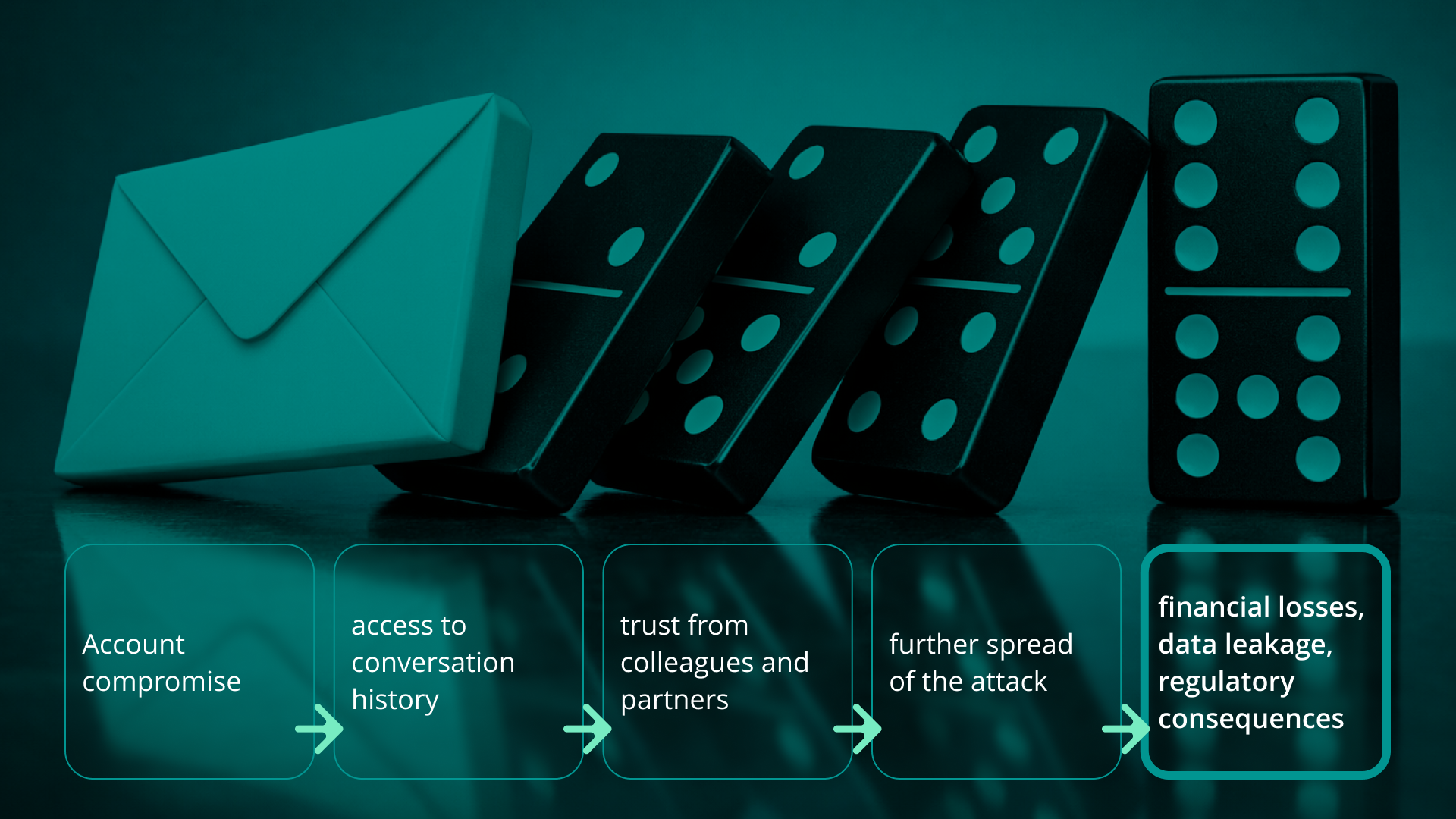
Email is one of the primary channels of business communication: approvals, financial requests, personal data, document exchange, and interaction with external counterparties all flow through it. That’s why the compromise of a single mailbox often becomes not an isolated incident, but an entry point into the rest of the business systems.
Attackers don’t choose email accidentally. This channel combines three critical factors:
- Trust: Messages from colleagues, executives, or partners rarely raise suspicion.
- Context: A mailbox contains communication history, documents, writing style, and decision-making hierarchy.
- Connectivity: Access to email often opens the door to cloud services, file repositories, and internal systems.
Once an attacker gains control of an email account, they can interfere with normal workflows and use the mailbox as a platform for further attacks, from financial fraud to large-scale data exfiltration.
The human factor as a catalyst in the incident chain
Around 60% of security incidents are linked to human factors in one way or another. Even experienced users still open attachments, click links, and reply to emails that look logical and appropriate.
What makes this worse is that modern attacks no longer look suspicious. Generative AI enables highly personalized, grammatically flawless messages that blend naturally into a work context and lack the classic “red flags.” As a result, user error stops being an exception — it becomes an expected step in the attack chain.
The illusion of safety: why email security is often underestimated
Most organizations already have baseline email protection: built-in capabilities of cloud email services, anti-spam, and filtering of known threats. This creates a sense of control — and a paradox: the channel that carries the highest volume of attacks is treated as one that doesn’t require rethinking.
The problem is that most modern attacks:
- don’t look anomalous;
- don’t violate formal policies;
- don’t have clear technical indicators.
They fit into normal business workflows, and that’s precisely why they go unnoticed.
Email security as a purely technical task
Another factor is the oversimplified view of what email risk actually is. Email is often treated as a transport channel — just another place to filter traffic.
In that model, the key question is: Is the email malicious?
But real incidents increasingly don’t fit this binary logic. Risk is often hidden in the content of a document, the structure of an attachment, metadata, the communication context, and in who is sending information to whom and why.
As long as email security remains purely a technical function, a large part of that risk never even enters the field of view.
The human factor as an “uncontrollable variable”
Even when organizations acknowledge social engineering, they often reduce the problem to user behavior. But modern phishing is no longer the obvious scam with “a fortune in Africa” or unbelievable lottery wins.
Phishing has become personalized, contextual, and built on trust in familiar senders and services. And it is increasingly generated with AI, which boosts credibility, further reducing the effectiveness of awareness training as the only line of defense.
When content complexity becomes visible too late
Another reason: users rarely think about the true value of what they are communicating. They don’t usually consider that documents can contain hidden data, attachments may include active content, and metadata can reveal internal information.
These risks become obvious only after an incident has already happened.
Conclusion: the problem isn’t email — it’s the approach to protecting it
Email is the link that connects people, data, and processes — both inside the organization and with external parties. It is often the start of the incident chain, which is why it must be protected as thoroughly as identities and endpoints.
Traditional approaches to email security no longer match the nature of today’s threats. That’s where the need emerges for a different security logic — one that works not only with threats, but with content, context, and data risk.
Modern email communication risks: how the incident chain forms
Email-related incidents rarely start with a “major breach.” More often, it’s a sequence of events — each one seemingly non-critical on its own. That’s why they stay off the radar until the dominoes reach the final hit.
1. Credential compromise
According to Fortra’s consolidated threat analytics for Q3 2024, credential theft is the most common email threat type:
- Credential theft — about 50% of all processed email threats
- Response-based attacks (emails requiring an action or reply) — 41%
- Malware — only 12%
- Social engineering is involved in roughly 60% of successful breaches
This fundamentally changes how we should view email risk: from an attacker’s perspective, email is increasingly a channel for establishing trust.
Once an attacker gains access to an account, the incident shifts into a new phase: the attack no longer looks external.
2. Response-based attacks as the new normal
According to Fortra’s Email Threat Intelligence Report 2025, phishing sites and response-based schemes make up 99% of all email threats. That means almost all attacks target user behavior rather than exploits, which is why classic signatures and blocklists are losing effectiveness.
Response-based attacks fit business logic perfectly: a request to “confirm,” a message “replying to a previous discussion,” an email from a partner, or a service already used by the organization. As a result, people see no reason to distrust it.
3. Hidden content and attachment complexity
Modern documents include multi-layer archives, embedded objects, active content (macros, scripts), metadata, and revision history. Most traditional email solutions:
- don’t analyze attachments recursively;
- don’t deeply inspect heavily packed content;
- let password-protected files pass without inspection.
As a result, sensitive data can leave the organization unnoticed, without an explicit policy violation, while the incident still doesn’t appear “critical.”
4. Social engineering at scale
According to the ENISA Threat Landscape 2025, phishing remains the main initial access vector, accounting for roughly 60% of recorded cases.
The key shift is the industrialization of attacks: phishing-as-a-service platforms, mass brand cloning, abuse of legitimate services, and QR-code phishing (quishing) that bypasses traditional filters.
5. Regulatory violations
When the chain reaches this stage, the incident stops being “technical.” Data leakage or compromise via email already implies:
- violations of GDPR, HIPAA, PCI DSS, and NIS2 requirements;
- the need to prove “appropriate security measures”;
- fines, audits, and reputational damage.
Regulators don’t focus on intent. They focus on whether the organization controlled the channel through which data moved. That’s when it becomes obvious: email is not a peripheral risk — it’s a critical accountability point.
What is Fortra Clearswift, and what role does it play in cybersecurity architecture?
Unlike classic email security solutions that focus on blocking known threats, Fortra Clearswift is built around a different mission: controlling risks that arise from the content of business communications itself — regardless of whether an email looks “malicious” in the technical sense.
Clearswift is a platform for securing email communications and performing deep content inspection, designed to reduce the risks of data leakage, distribution of harmful content, and regulatory violations through legitimate information-sharing channels. Its logic was shaped in environments where email is a mission-critical work tool and where mistakes, leaks, or uncontrolled information exchange have direct legal, financial, or reputational consequences.
Email as part of the content perimeter
In traditional security architectures, email is usually treated as transport: a message either passes or gets blocked.
Clearswift uses a different model. It treats email as one of several content movement channels, alongside web traffic, file sharing, partner integrations, and internal communication.
That shift matters because the focus is no longer the channel but what flows through it.
Not “blocking” but managing risk
In real business environments, documents can contain both useful and risky information, data may be only partially sensitive, and communication cannot always be stopped without operational impact.
That’s why Clearswift manages risk precisely, analyzing structure, content, and context instead of making binary decisions. The key idea is that not every risky email must be blocked, and not every file is either “safe” or “malicious.”
Clearswift’s role in the broader protection model
Clearswift does not replace antivirus, SOC tools, endpoint protection, or network security.
Instead, it addresses the risk zone that often sits between classic security layers:
- data leaks through legitimate channels;
- sensitive data in attachments;
- active or hidden content in documents;
- human mistakes that don’t look like policy violations.
Historically, this approach to email and content security emerged for environments where stopping communications is unacceptable, data accountability is strictly regulated, and leak consequences extend beyond an IT incident.
That’s why Clearswift is widely used in sectors with high compliance and information-flow control requirements, such as large enterprises, healthcare organizations, financial institutions, government agencies and entities, and defense industry environments.
From “email security” to content governance
In the context of modern threats, Clearswift demonstrates an important evolution: from securing the channel to controlling the content and context of communications.
It doesn’t negate traditional security controls. It complements them where attacks don’t look like attacks, where data leaves the perimeter without obvious violations, and where risk accumulates gradually, step by step.
How Clearswift works: key principles
Deep Content Inspection regardless of whether the threat type is known in advance
Clearswift’s core principle is the full understanding of file structure rather than surface scanning. In practice, the system deconstructs documents and archives into their components, recursively analyzes nested attachments, and processes multi-layer structures that traditional filters often miss.
This enables the detection of sensitive data buried deep within a document, active content, hidden objects, and embedded files.
Structural Sanitisation – neutralization without blocking
Another key principle is protection without stopping business communications. Instead of blocking an entire file or allowing it through unchanged, Clearswift identifies dangerous elements (macros, scripts, active code), removes only those elements, and delivers a cleaned version to the recipient.
Risk is neutralized, and the user still receives a usable document without delays.
This is especially important in environments where blocking emails can stop processes or introduce operational risk.
Adaptive Redaction – controlling data, not banning exchange
Clearswift assumes that not all of an email is problematic, often only a specific fragment is.
Adaptive Redaction automatically detects sensitive data (PII, financial information, identifiers) and masks or removes it while leaving the rest of the content available for business use.
This shifts DLP from blanket prohibition to controlled sharing and from manual review to automated policies.
Document Sanitisation and addressing “invisible” risk
A separate class of threats comes not from obvious content but from metadata: author names, internal comments, revision history, and technical details about the environment where a file was created.
Clearswift automatically removes this data before sending, reducing social engineering risks, internal structure reconnaissance, and preparation of targeted attacks.
Anti-Steganography – when threats are hidden inside images
Modern attacks increasingly use steganography, hiding data inside image files.
Clearswift analyzes image structure, detects “gaps” that could carry hidden code, and reconstructs the file, keeping only the safe visual layer. This neutralizes threats that bypass text- and signature-based mechanisms.
Context and policies instead of universal rules
Another fundamental principle is context awareness. Clearswift considers who the sender and recipient are, whether communication is internal or external, the data type, and regulatory requirements for the specific scenario.
Based on this, different actions can be applied: sanitization, redaction, encryption, or delivery through alternative channels.
Together, these mechanisms create an approach where risk is reduced to an acceptable level, communication continues uninterrupted, and control is enforced at the content level — not just the channel level.
That’s why Clearswift performs effectively where classic filters lose context and see only an “email,” not the chain of potential consequences.
Practical use cases for Clearswift
Clearswift demonstrates its value in everyday situations that often go unnoticed until an incident occurs:
- Outbound email protection. Identifies sensitive data in attachments and message text, automatically redacts or masks it, and enforces policies without user involvement, reducing risk without disrupting business processes.
- Controlled exchange with partners and contractors. Removes metadata and internal comments, automatically applies different policies for internal vs. external recipients — critical where a single email mistake can have legal consequences.
- Protection against malicious attachments. Neutralizes active content, delivers sanitized documents, and reduces zero-day risk without waiting for signatures. The file reaches the user, but the attack chain is broken.
- Compliance-driven policies. Supports data-type-based policies, automatic encryption or redaction, plus auditing and traceability, turning email from a “weak link” into a controlled process.
Who benefits most from Clearswift
Clearswift is not a universal “tool for everyone.” It is most relevant where the cost of a mistake is high:
- Healthcare: personal and medical data, strict confidentiality requirements, high penalties for data leaks.
- Financial services: financial information, payment data, regulatory oversight, and higher attacker interest.
- Government: internal and interagency communications, citizens’ personal data, transparency, and accountability requirements.
- Large enterprises: high email volumes, complex approval chains, elevated risk of human error.
- Defense: critical data, exchange with partners and international structures, heightened relevance in wartime and hybrid threat conditions.
Final thoughts
Email remains a catalyst in most modern cyber incidents, not because it is technically weak, but because it carries content, context, and trust.
Modern threats show that email security is no longer about spam or phishing alone. It is about managing data risk in business communications. That’s why email needs a deliberate, content-oriented approach capable of stopping the incident chain before it gains momentum.