Azerbaijan
 Bosnia and Herzegovina
 Bulgaria
 Croatia
 Czech Republic
 Denmark
 Estonia
 Finland
 Georgia
 Hungary
 Kazakhstan
 Kyrgyzstan
 Latvia
 Lithuania
 Moldova
 Montenegro
 North Macedonia
 Norway
 Poland
 Romania
 Serbia
 Slovakia
 Slovenia
 Sweden
 Tajikistan
 Turkmenistan
 Ukraine
 Uzbekistan

The forum’s primary discussions centered on technologies that are already transforming the approach to digital infrastructure development. Participants explored practical AI use cases, the evolution of smart city projects, data center transformation, Industry 4.0, modern telecom infrastructures, and investments in technological ecosystems.
At the exhibition, BAKOTECH showcased cutting-edge solutions in cybersecurity, cloud security, application security, network visibility, and AI-driven analytics. Featured key vendors included Cloudflare, CyberArk, F5, Fortra, NETSCOUT, Palo Alto Networks, Snyk, Syteca, Tenable, Trellix, and Nozomi Networks.
Following the forum’s insights, we invite you to look ahead at how AI will shape cybersecurity in the coming years and which technologies will soon become definitive for businesses.
Watch the video below to see our roundup of expert commentary from BAKOTECH and leading global IT solution providers.
How Cybersecurity Is Changing in the Age of AI
One of the central topics of the event was the rapid pace at which artificial intelligence is reshaping the information security market. The forum made it clear: the industry has moved past discussing “promising technologies” and is now focused on practical scenarios where AI handles threat analysis, SOC automation, and incident response.
Farkhad Akhmadov, Territory Manager at BAKOTECH:
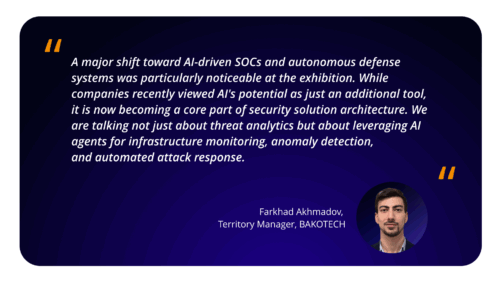
However, the rise of autonomous systems also introduces new risks. Aibek Taubaldiev, Business Development Manager at BAKOTECH, notes:
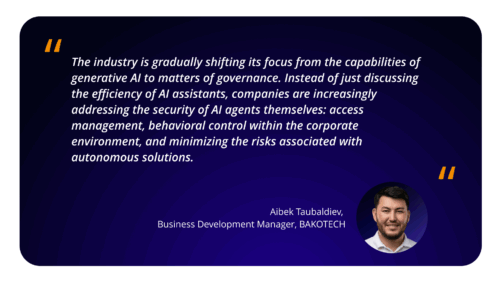
As businesses more actively integrate AI into their cybersecurity processes, securing these intelligent systems themselves is becoming increasingly critical.
Why Off-the-Shelf Approaches Don’t Work for the Central Asian Market
Global cybersecurity trends reach Central Asia with virtually no delay. However, their implementation in the region follows its own unique path. Forum experts agreed that transplanting Western AI use cases onto the local market “as it is” makes little sense. Too much depends on infrastructural maturity, local talent expertise, and regulatory compliance.
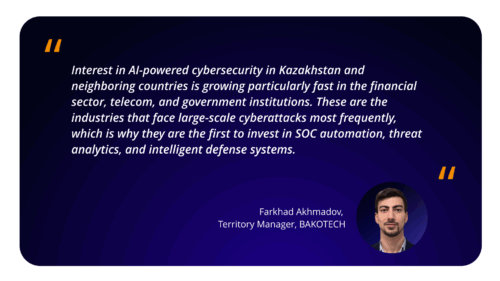
However, widespread AI adoption in the region is still held back by highly practical challenges.
“Businesses remain cautious about fully autonomous AI solutions,” notes Aibek Taubaldiev. “The main reasons include a shortage of local expertise and the friction of integrating new tools into existing infrastructure — which in many companies was built over years and isn’t always ready for deep automation.”
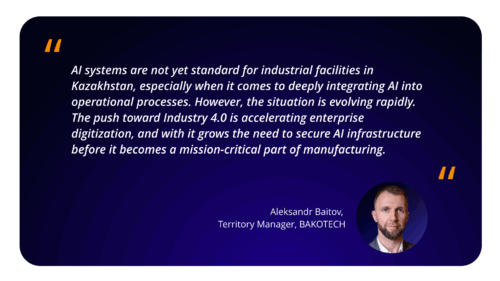
The industrial sector presents its own distinct set of challenges. Aleksandr Baitov, Territory Manager at BAKOTECH, explains:
“At the same time, the AI security market is evolving almost in step with generative AI. And it is precisely this race between technological advancement and security that is now becoming one of the main challenges for businesses.”
Shadow AI, Deepfakes, and Data Leaks: New Threats to Business
The rapid boom in generative AI has not only reshaped how companies approach automation; it has also fundamentally altered the mechanics of cyberattacks. Threats that once required weeks of preparation and an entire team of specialists can now be scaled in a matter of minutes.
Farkhad Akhmadov:
“Generative AI has drastically lowered the barrier to entry for cybercriminals. Companies in the region are increasingly facing next-level phishing attacks, where emails, messages, and even voice notes are virtually indistinguishable from genuine communications. Deepfake scenarios and automated social engineering are becoming cheaper to execute, which means they are becoming accessible for mass deployment.”
Simultaneously, another challenge is emerging: Shadow AI.
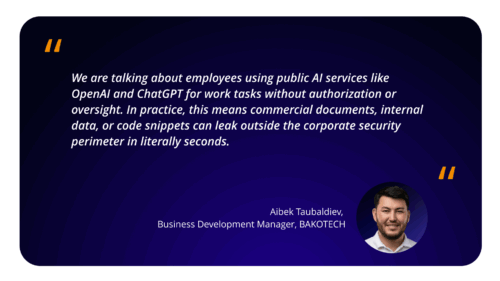
This issue is becoming exceptionally sensitive for heavy industry, banking, and the telecom sector.
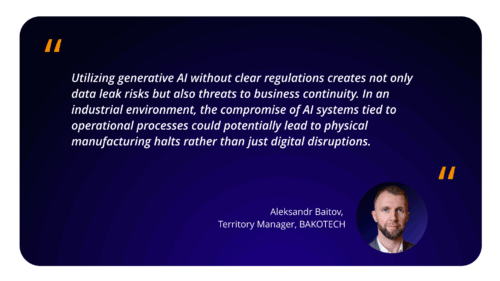
“Additional risks are emerging as banks and telecom operators trend toward developing their own in-house LLMs (Large Language Models). The deeper AI integrates into corporate processes, the wider the attack surface becomes, opening the door to context manipulation, model tampering, and breaches of AI system integrity.”
This is precisely why securing AI infrastructure is rapidly evolving into a distinct branch of cybersecurity. Among the solutions actively used today to govern AI interactions, experts highlight products from Palo Alto Networks, including AI Access Security and Prisma Access Browser (geared toward securing AI environments and managing risks associated with generative AI usage).
Business in the Age of AI: Where Automation Ends and Risks Arise
Companies are increasingly leveraging AI to automate routine operations, analyze threats, monitor networks, and accelerate the work of SOC (Security Operations Center) teams. However, this shift is altering the very logic of cybersecurity, as legacy defense models struggle to keep pace with new attack vectors.
Farkhad Akhmadov notes:
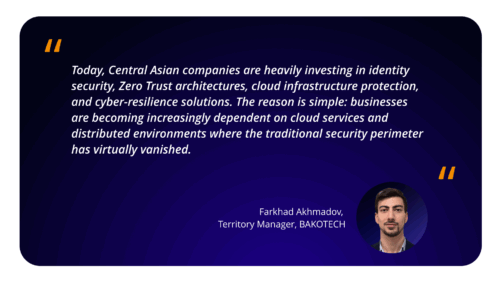
This transformation is well illustrated by the CyberArk solutions showcased by the BAKOTECH team at the exhibition. With AI driving highly automated attacks, defense mechanisms must transition to an automated footing as well. The focus is shifting from protecting individual users to controlling all credentials, including machine identities and service accounts. This exact approach serves as the foundational bedrock for Zero Trust architectures and the safe integration of AI tools into the corporate ecosystem.
Aibek Taubaldiev adds:
“Businesses are forced to rebuild their defense strategies because the nature of cyberattacks themselves has changed. Threat actors are relying decreasingly on malware alone. Instead, they leverage stolen credentials, cloud service compromises, misconfigurations, and human-error-driven attacks.”
Consequently, companies find themselves in a new reality where infrastructure defense can no longer be reduced to traditional antiviruses and firewalls. The paramount objective is now robust access control, complete user activity visibility, and system resilience in the face of continuous attacks and the growing footprint of AI on business processes.
The Distributor as a Technological Guide
The evolution of digital infrastructure and the growing complexity of cyber threats — both major talking points at GITEX 2026 — are reshaping not only technology itself but the very architecture of the IT market. In this new reality, the role of the distributor is undergoing a transformation: shifting away from a mere logistics link and increasingly moving toward becoming a technological partner and an integration hub.
“Today, a distributor operates far beyond the traditional product delivery model,” confirms Farkhad Akhmadov. “The focus has shifted to technical expertise, team training, supporting pilot projects, and adapting global technologies to the specific needs of the local market. This approach allows us to do more than just ‘bring’ technologies to the region — it enables us to seamlessly integrate them into companies’ actual business processes.”
Aibek Taubaldiev echoes this idea:
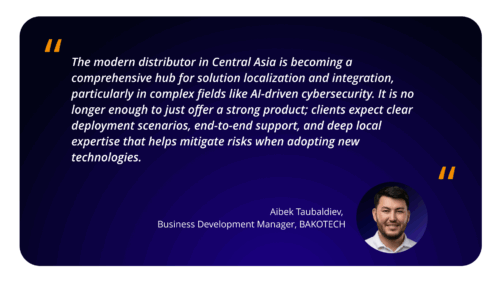
Ultimately, the distribution model is steadily pivoting toward technological consulting, where the primary asset is no longer just a vendor portfolio but the proven ability to transform complex solutions into turnkey, functional business tools.
Conclusion
Discussions at GITEX 2026 clearly demonstrated that artificial intelligence is steadily becoming a foundational element of the defense architecture upon which modern IT systems are built. The market’s focus has fundamentally shifted; instead of speculating about technological capabilities, companies are now actively discussing risk management, automated response, and restructuring security models to fit the new digital reality.
For Central Asia, this shift is particularly significant. Accelerated digitization, expanding cloud infrastructures, and a rising volume of cyberattacks mean that adopting AI-driven security is no longer a strategic option; it is a practical necessity.
“AI is becoming the new industry standard, and the market will inevitably demand higher qualifications from specialists,” notes Aibek Taubaldiev. “In the coming years, the competitiveness of partners and integrators will be dictated by the depth of their expertise in key areas: AI-native AppSec, cloud security, and insider risk management.”
“Within the next 3 to 5 years, AI will become a true ‘co-pilot’ for IT and security teams, taking over a major portion of routine tasks,” predicts Farkhad Akhmadov. “Consequently, the core competencies of specialists will expand beyond technical skills to include AI-tool proficiency, analytical thinking, and continuous upskilling. Companies that begin adopting an AI-driven approach today will secure a major advantage in threat detection speed and overall infrastructure resilience.”
Ultimately, the industry is entering a phase where technological superiority directly depends on the ability to not just deploy AI but to transform it into a manageable, integrated component of the digital architecture.
If you want to strengthen your cybersecurity posture using AI-based solutions from leading global vendors, fill out our form to request a consultation with the BAKOTECH team.
Subscribe
Get free professional consultation on manufacturers, products and services