
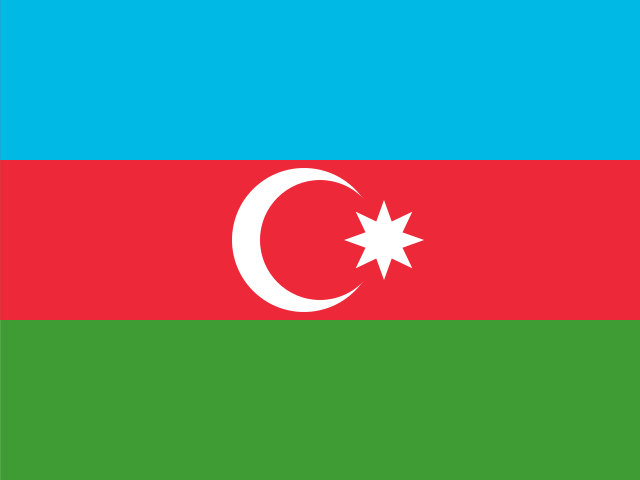
 Azerbaijan
 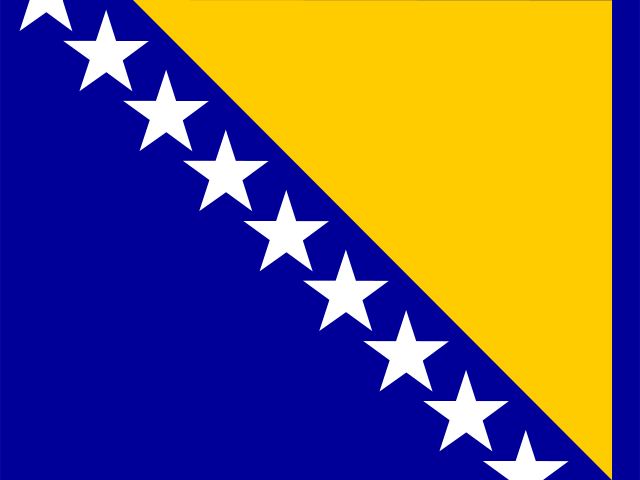 Bosnia and Herzegovina
  Bulgaria
  Croatia
  Czech Republic
  Denmark
  Estonia
  Finland
  Georgia
  Hungary
  Kazakhstan
  Kyrgyzstan
  Latvia
  Lithuania
  Moldova
  Montenegro
  North Macedonia
  Norway
  Poland
  Romania
 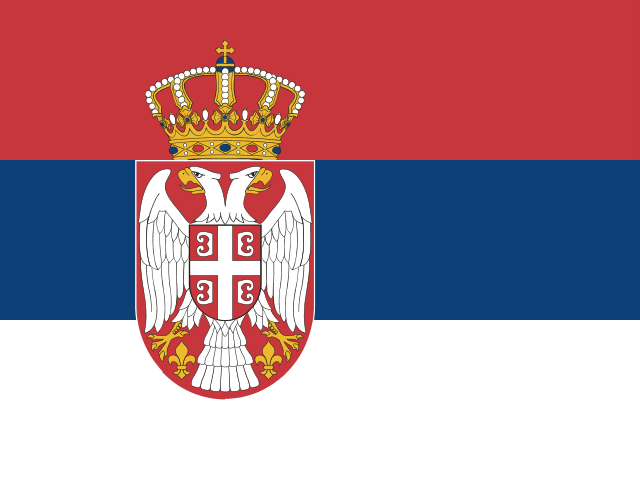 Serbia
  Slovakia
  Slovenia
  Sweden
  Tajikistan
  Turkmenistan
  Ukraine
 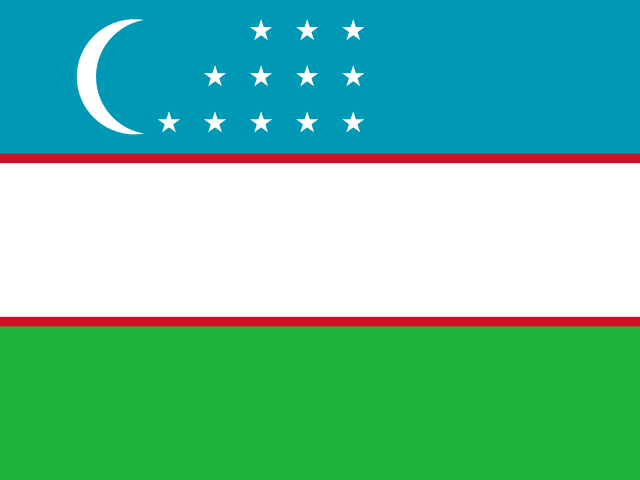 Uzbekistan
Cybersecurity is its own kind of rock ‘n’ roll. In this world, the IT infrastructure is our stage, and instead of a world tour, we embark on targeted roadshows to exchange knowledge with our peers. Our instruments are the dozens of security solutions that must perform in perfect harmony. Much like a rock band, if every member plays their own tune, the music quickly collapses into noise. Disconnected tools without a unified logic don’t actually strengthen your defense; they simply create an illusion of control.
This was the core philosophy behind our recent roadshow. BAKOTECH traveled across the Baltic states — Lithuania, Latvia, and Estonia — to dive deep into current trends and challenges. Our goal was to demonstrate how a strategic approach to protection, powered by Skyhigh Security, can harmonize these disjointed elements and solve critical security pain points.
Here are the key insights from the tour.
Key roadshow questions
In today’s landscape, the winner isn’t the one with the most solutions, but the one whose tools work as a unified whole.
In such an environment, the Skyhigh Security technology stack stands out as a cohesive system that covers multiple layers of infrastructure protection without the need for manual ‘stitching’ or integration.
The stack itself consists of the following solutions:
- Skyhigh Security Web Gateway (SWG) — traffic and user behavior monitoring. Allows you to see what’s happening on the network in real time and manage risks before they turn into incidents.
- Skyhigh Cloud Access Security Broker (CASB) — cloud control without losing flexibility. Eliminates one of the most painful dilemmas: how to not prohibit employees from using cloud services, but at the same time maintain control over data.
- Skyhigh Private Access (ZTNA) — secure access without a classic perimeter. It treats access as a variable, not a static rule. Users receive exactly the access they require, exactly when they need it.
- Skyhigh Cloud-Native Application Protection Platform (CNAPP) — cloud infrastructure protection at the architecture level.
During our presentations and discussions, BAKOTECH partners were particularly interested in the fact that these solutions build an entire ecosystem to improve the level of protection of both cloud and on-premise infrastructure.
The idea that served as a central theme in almost every conversation is simple yet uncomfortable:
Today, the problem is not a lack of tools but their fragmentation.
When security is divided into dozens of solutions, there are always blind spots between them, which is where the most interesting stuff happens.
Therefore, the focus shifts from “which product is better to choose” to “how to build a system that will have solutions for on-prem and cloud in its arsenal.”
What are the key concerns in the security solutions market?
If we collect all our conversations with partners into one story, it becomes clear that the cybersecurity market today is not so much about a lack of solutions but about the complexity of existing with them.
We have conventionally distinguished four main concerns.
- Multi-vendor chaos has become the norm
Most companies have long since moved beyond the boundaries of a single vendor. Five, seven, or ten different solutions are the standard configuration because, historically, no single vendor has been able to cover all the tasks at once.
However, along with flexibility comes a side effect — fragmentation.
Integrations become more complex, control is dispersed, and “gray areas” appear between systems that are difficult to track.
- The cloud is a new, dynamic attack perimeter
The move to the cloud has solved many business problems. At the same time, it has created a new level of risk.
Cloud services have become a major entry point for attacks. The main concern here isn’t even the threats themselves; it’s about visibility. Companies often do not fully understand which services are actually used, how data moves, and where exactly the risks arise. Shadow IT also creates problems, so in the end it turns out that part of the infrastructure exists outside official control and continues to actively work with corporate data.
- AI: already a reality, already out of control
Artificial intelligence has rapidly evolved from an abstract innovation on the horizon into a daily workplace reality. Employees are now using AI services for their tasks — sometimes even more frequently than their company’s internal tools. It’s impossible to ban it as well as ignore it. Negligent AI usage brings a wave of consequences: data leakage risks, a lack of oversight regarding queries and outputs, and a total lack of transparency. We are facing an entirely new class of challenges that many organizations are simply not yet equipped to handle.
- Out-of-the-box solutions as an illusion of protection
It’s a common story: a solution is officially deployed, but in practice, it’s barely scratching the surface of its potential. This is especially evident with DLP. Without finely tuned policies, data classifications, and regular expressions (regex), the system remains more of a “check-the-box” formality than a functional security tool.
In reality, security effectiveness always begins after implementation, at the stage of adaptation to a specific business. This is where the gap between expectations and results often arises.
While this list of challenges could go on, these four points alone highlight a critical reality: the primary issue today isn’t a lack of technology, but rather the absence of a unified, intelligent approach to its implementation. Without the right configuration and strategy, even the most advanced ‘top-tier’ solution will fall short of its potential.
What can be done?
The recommendation is simple: take another sober look at the current problems and change your approach to tools. The focus now should be on understanding how coherently the solutions work. Skyhigh Security’s approach in this sense is quite indicative: it is built around the idea of a single ecosystem, not another point solution.
When various security functions are consolidated into a single platform, the need to manually stitch together a ‘patchwork quilt’ of tools disappears. Policies become unified, management is centralized, and telemetry is synchronized. This allows you to see the full picture instead of struggling with fragmented data that must be interpreted in isolation.
The next point is user control, regardless of where they work.
In today’s infrastructure, the user is no longer tied to the office or even a specific network. Naturally, security controls must follow the user wherever they go. A Secure Web Gateway (SWG) accomplishes exactly this, covering all web traffic — whether it’s directed toward internal corporate services or external public resources.
CASB adds control over cloud services with policies and DLP. A Cloud Access Security Broker protects cloud applications with a built-in DLP module that enables active monitoring of user use of web services and verification of compliance with company policies for these services.
As a result, the company receives not just a set of logs but a holistic understanding of how users, data, and services interact.
Another frequent question is, how do we secure access? The traditional VPN has long since become a bottleneck — it either grants too much access or overcomplicates the user experience. Private Access (ZTNA) fundamentally changes the approach: access is granted on a granular, per-request basis, deeply rooted in context. Furthermore, it integrates seamlessly with existing web and cloud security policies from day one.
Fewer “extra doors” in the system and fewer opportunities to go where you didn’t plan.
When it comes to controlling data as a process, not an event, the Cloud-Native Application Protection Platform adds another important dimension — working with data in motion. You can understand not only where data is now but also how it appears, changes, and moves within the infrastructure.
This allows you to close the same blind spots that usually occur between different environments and teams.
A separate focus is simplifying implementation, because even the strongest platform is pointless if it is difficult to launch.
Ready-made policies, pre-configured classifications, and using AI to generate the same regular expressions or rules are not about convenience for convenience’s sake, but about speed and reducing dependence on experts, who are always in short supply.
Ultimately, this logic leads to a very practical conclusion: security becomes truly effective only when the entire system finally functions as a unified whole.
Briefly about the main insights from the roadshow
The bottom line is that our conversations pointed to several clear market signals.
The greatest resonance came from Skyhigh Security’s ecosystem approach — not as a mere concept, but as a practical remedy for daily “tool sprawl.” Closely following this was the demand for cloud service control and the urgent topic of AI, which has shifted from a future trend to a “solve-it-now” priority.
Perhaps the most significant shift, however, is in the mindset itself. Interest is moving away from simply selecting products and toward building a security architecture where every solution operates within a unified ecosystem.
For us, the most telling sign was how easily partners recognized their own challenges in these cases. This confirms we aren’t seeing isolated hurdles, but systemic issues facing the entire market.
Conclusions
The cybersecurity market is moving in a direction that is predictable yet challenging. Infrastructure complexity is outpacing organizations’ ability to manage it. Consequently, the next logical step isn’t to stack more tools but to master what we already have — treating our existing environment as a single, unified system.
That is why our upcoming initiatives will focus on practical matters: from technical sessions to demonstrations of specific use cases, so you can see how the Skyhigh Security approach works in real conditions.
It is worth paying special attention to the webinar Skyhigh CASB: Control and Protection of Access to Cloud Services, where these topics will be explored in more depth, with a focus on use cases and practical approaches to building security. Registration is now open, and it’s a good way to move from the big picture to specific solutions that you can apply to your infrastructure.
In the end, as in rock and roll, the winners are not those who simply try to shout over the noise of new threats but those who know how to assemble their system into a coherent sound and rebuild it in time for the new reality.
It’s a long way to the top. But the climb becomes much easier when the whole band is performing in perfect harmony.
If you need advice on Skyhigh Security solutions, please contact us at [email protected]
Subscribe
Get free professional consultation on manufacturers, products and services


